
TLDR: To get consulting clients on LinkedIn, define one buyer and one problem, make your proof easy to check, then find people already discussing that issue. Check the person and company before you act. Comment when you can help, message when you have a clear reason, and skip weak fits.
The best way to get consulting clients on LinkedIn is to start with a narrow promise and a real conversation. Say who you help, what problem you solve, and what proof you have. Then look for people discussing that problem, check whether they fit, and respond to what they actually said.
A consulting client is a company or buyer paying for your judgment and work. LinkedIn and Edelman's B2B thought leadership research found that 73% of decision-makers saw thought leadership as a more trustworthy way to judge an organization's ability than its marketing materials. A clear point of view and good proof help before the first call.
But posting every day isn't a client-finding system. You still need to know whom to watch, when to join a conversation, and when to leave someone alone.
Start with your ideal client and one problem
"I help businesses grow" is too broad to guide a search, post, comment, or message. A useful ideal client definition gives another person enough detail to recognize a possible buyer for your consulting services.
Write down four things:
- The kind of company you help
- The person closest to the problem
- The problem you solve
- The result or proof you can discuss
For example, an operations consultant might help owner-led manufacturers with 5 to 50 employees fix slow quoting and poor handoffs. A marketing consultant might help B2B software companies lower paid acquisition costs after a product launch.
These descriptions are useful because the company, person, problem, and proof can all be checked. They also make referrals easier. A former client may not know anyone looking for "business consulting," but they may know a manufacturer whose quoting process is holding back new work.
Keep one offer in focus for the first LinkedIn search. If you mix finance, operations, hiring, and marketing problems in the same client acquisition effort, you won't know why one person replied and another did not.
Make your LinkedIn profile answer the buyer's questions
For a consulting business, your profile doesn't need to tell your full career story. It needs to answer what you do, who it is for, and why the buyer should believe you.
Use a clear, recent profile photo. Keep your current role and offer easy to understand. Your profile should not look abandoned. A buyer who reads your comment or message may check it before replying.
Put the client and result in the headline. "Operations consultant" is a label. "I help small manufacturers shorten quoting and delivery delays" gives a potential client something to compare with their own situation.
Use the first lines of the About section to explain the problem in the buyer's words. Then add one concrete example of work you have done. A result, a short case study, or a clear method is stronger than a long list of skills.
The Featured section can hold the proof a buyer may want next. Add a short case study, a client testimonial, or one practical guide that shows how you think. A testimonial gives social proof. A case study helps the buyer see whether you have solved the same kind of problem. Remove private client details when needed, but keep the problem, choice, and result clear.
Posts and comments show that you still do this work. You do not need to post every day. Share lessons from real work from time to time. Write about mistakes you found, choices you made, and lessons a client can use. Generic advice may earn likes. Specific work gives a prospective client a reason to trust you.
Where can consultants find potential clients on LinkedIn?
Finding consulting clients gets easier when you start where the client, problem, or relationship is already visible. Your existing network and past clients give you trust. Search gives you market coverage. Posts and comments give you current context. Creator audiences can reveal target clients who use different words for the same problem.
| Source | What to look for | Use it when |
|---|---|---|
| Past clients and work contacts | A new role, company change, referral, or old problem returning | Trust already exists |
| LinkedIn search | The right role, company size, industry, and location | You need to map the market |
| Posts and comments | A person describing a problem, failed attempt, question, or priority | You need a current reason to respond |
| Creator or competitor audiences | Buyers joining discussions around a person your market follows | Keyword searches attract peers or vendors |
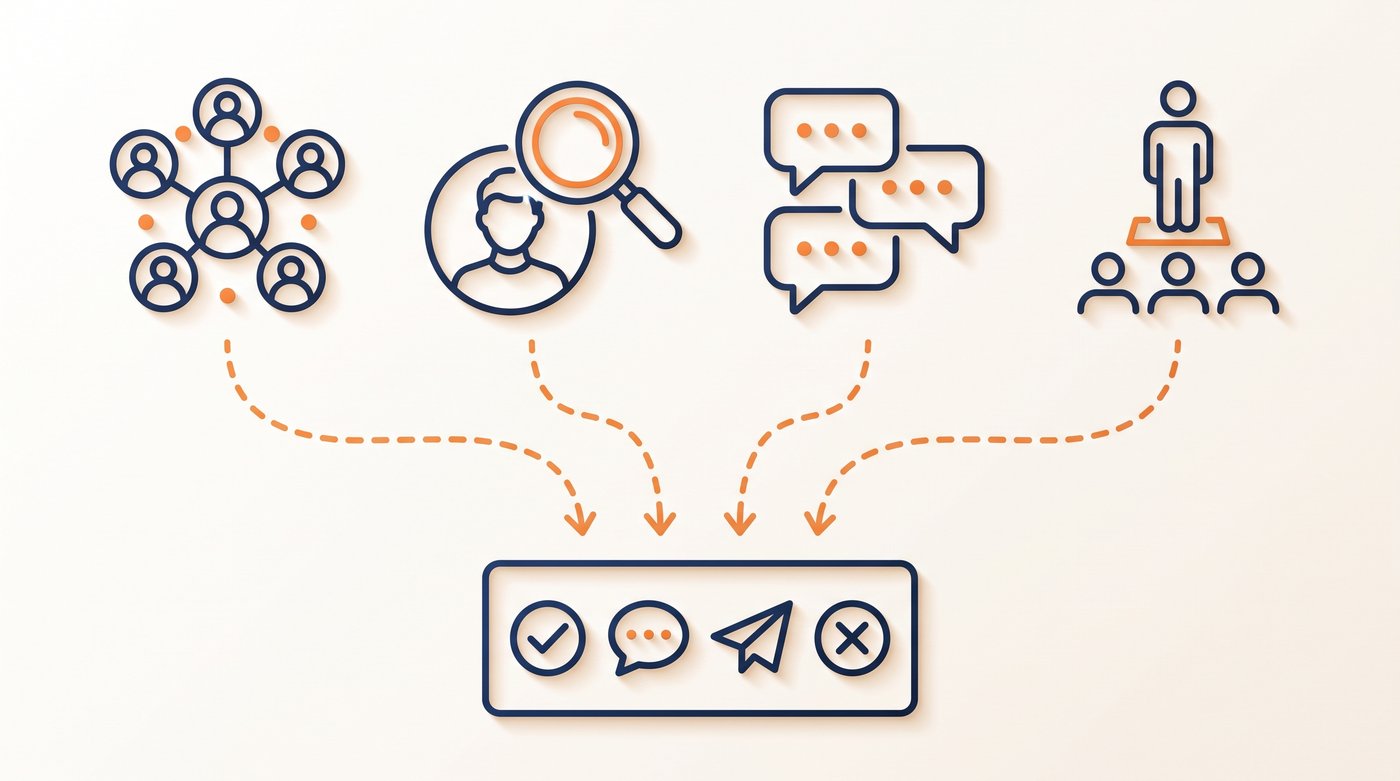
Start with your existing network. Former clients, employers, partners, and people who know your work can refer you or reopen an old conversation. Send a useful update, ask about a change you noticed, or share a case that fits their current work. Don't hide a pitch inside a fake catch-up.
Use LinkedIn Sales Navigator when standard search is too shallow. It helps you filter accounts and people, save useful searches, and read alerts. The search tells you who may fit. You still need a reason to contact the person.
Posts and comments provide that reason. Look for buyers asking for help, describing a process that failed, comparing choices, or explaining a constraint you know how to fix. The language matters more than the reaction count.
Creator audiences are useful when the right buyers gather around a trusted voice. In one consulting creator-audience run, 37 people appeared and five were worth reviewing after the role, company, location, and fit checks. The useful result was a supply chain director whose comment named a real business constraint, not the size of the raw list.
How do you know which people are worth contacting?
A LinkedIn profile match is only the first check. Keep the person when the company fits your work, the role is close to the problem, and the conversation gives you something useful to respond to. Research when one part is unclear. Skip when the company, role, problem, or timing does not fit.
Use this short review:
- Does the company match the size, market, and location you can serve?
- Is the person close to the problem or the decision?
- Have they said or done something connected to the problem?
- Do you have proof that fits their situation?
- Can you explain why you chose them without saying they matched a filter?
The first two questions check fit. The next two check relevance. The last one stops a generic consulting pitch before it is sent. The goal is to find the right clients, not build the biggest list.
Do not turn every weak clue into buying interest. A person commenting on a leadership post may be a peer, job seeker, vendor, or employee at a company you cannot help. Read the comment, open the profile, and check the company.
Choose a useful comment or a direct message
Comment when you can add something that helps the person or the wider discussion. Message when the person has named a problem, asked a question, or shared a change that creates a clear private conversation.
A useful comment adds a detail from your experience. It may point out a tradeoff, give a small example, or ask a question that moves the discussion forward. "Great post" builds no authority. A disguised pitch is worse.
For example:
We saw the same delay when approvals moved between sales and operations. The useful fix was giving one person ownership of the handoff, not adding another form. Is ownership or missing information the bigger issue for you?
A direct message should keep the same logic. Refer to the post or comment, connect it to a pattern you know, and ask one question the person can answer without booking a call.
Your comment about quotes taking a week stood out. I have seen the delay come from product rules as often as the quoting tool. Is the team waiting on technical input, pricing approval, or both?
Neither message announces a consulting service. Both show why the consultant wrote and make it easy to continue the conversation. The offer can come later if the problem and fit are real.
The LinkedIn comments method gives the full process for choosing people from a live discussion and writing from their words.
Use proof before you ask for a call
Consulting clients buy judgment. Give them enough evidence to see how you think before you ask for time.
Proof can be a case study, a clear result, a useful comment, or a short post that explains a decision. The best examples name the starting problem, what you changed, and what happened. "Helped a client improve operations" says almost nothing.
LinkedIn's research found that nine in ten decision-makers and senior executives were more receptive to outreach from a company that consistently produced high-quality thought leadership. The point isn't to become a full-time creator. It is to make your experience visible enough that a buyer can check it.
Match the proof to the person. A finance director needs a different case than a founder. A small services firm may care about speed and owner time. A larger company may care about risk, coordination, and whether the change can work across several teams.
Ask for a call after the person has shown interest or the problem is clear enough to discuss. A useful first exchange is progress. Forcing a calendar link into every conversation is not.
Use one weekly routine to get consulting clients
Keep the routine small enough to repeat when client work is busy.
- Review one clear source: a saved search, creator, competitor, keyword, or past-client list.
- Check each person and company against the same client definition.
- Mark the next move: comment, message, research, wait, or skip.
- Follow up on open conversations where you have something useful to add.
- Record which source produced good fits, useful replies, calls, and clients.
This creates a simple client acquisition strategy. The source gives you people. The fit check removes noise. The conversation gives you context. The result tells you whether to keep the source.
Track the source, not only the final message. If one creator audience keeps producing owners in your market, keep it. If a keyword returns mostly other consultants, change the source. Better copy will not fix the wrong people.
When manual LinkedIn research stops fitting
Manual research works when you have a short list of prospective clients and time to read every conversation. It gets harder when you follow several keywords, creators, competitors, and posts, then repeat the same person and company checks each week.
Signado watches LinkedIn posts and comments around the sources you choose. It checks the person and company against your client profile, keeps what they said, and gives each lead a next move such as message, comment, research, or skip. That turns several open tabs into one reviewed feed.
The reason this can improve outreach is simple. The original words stay attached to the person. In our LinkedIn comments field test, classic profile targeting produced 25 replies from 139 messages. Starting from recent posts and comments produced 78 replies from 149 messages, or 52.3% compared with 18.0%, across 1,184 connection requests.
Signado never connects to your LinkedIn account. It does not ask for a login, cookie, or browser extension. It also does not replace your profile, case studies, relationships, broad Sales Navigator account search, or the judgment needed before you contact someone.
Use it when finding and checking live LinkedIn conversations is the repeated part of your weekly routine. Keep the manual method when your market is small and you can review the right sources yourself. See how Signado finds warm leads if the research and sorting are the parts you want handled.
Common questions
How do consultants find clients on LinkedIn?
Start with people who already know your work: past clients, employers, partners, and trusted contacts. Ask for a specific introduction or reopen a relevant conversation. Then use LinkedIn search and live discussions to reach beyond that network without lowering the fit standard.
What should a consultant post on LinkedIn?
Turn one piece of client work into a useful lesson without exposing the client. Explain the situation, the decision, and what you would do again. If the post could have been written without doing the work, add a real tradeoff, example, or result.
Should consultants send cold messages on LinkedIn?
Send a direct message only when you can explain why that person should receive it now. Remove the person's name and company from the draft. If the same message would still work for anyone with that title, it is too generic to send.
Do consultants need LinkedIn Sales Navigator?
No. Test the method with standard LinkedIn first. Pay for Sales Navigator when rebuilding searches wastes time, the free filters cannot isolate your market, or saved account alerts would change who you review each week.
What should consultants measure on LinkedIn?
Use a small sheet with one row per person. Record the source, fit decision, chosen action, reply, call, and client outcome. Define a useful reply as one that answers the question or moves the problem forward, not a polite reaction.
Find one useful conversation this week
Choose one buyer and one problem. Find a recent LinkedIn post or comment about it. Check the person and company, then add a useful comment or send one short question tied to what they said.
That is enough to test the method and start finding clients. If you want Signado to find, check, and sort those conversations without connecting to your LinkedIn account, start with one source.
Land your next client with something relevant to say
Signado finds the people already talking about what you do on LinkedIn, and shows you what they actually said. You reach out with a reason they'll recognize.