
TLDR: Founder led sales works because you hear what buyers need, change the offer, and act on feedback fast. Use referrals, cold email, LinkedIn messages, posts, comments, and calls as one simple system. Keep the judgment and client conversations. Hand off repeatable research and admin later.
Founder led sales means you find and win clients yourself before you hand the process to someone else. You choose the buyer, write the first messages, run the calls, follow up, and learn why people say yes or no.
That direct contact is the point. You can change the offer after three similar objections instead of recording them and keeping the old pitch.
Most guides call this startup sales or sales for startups. They are written for an early-stage startup founder selling software. The same idea works for agencies, consultants, and other B2B service businesses because the buyer often wants access to the person who understands the work and can make a decision.
The hard part is turning that access into a repeatable sales process without spending every day in random calls and inboxes.
What is founder-led sales?
Founder-led sales is a sales strategy where the founder owns the first client conversations. You choose the market, find possible buyers, start contact, run discovery and demo calls, handle objections, and close the work. Those conversations shape the offer and the process that follows.
Pete Kazanjy, author of the sales handbook Founding Sales, describes it as the work used to discover, refine, and scale the first sales motion. That includes the message, ideal client, prospecting, sales material, and early handoff.
For a service business, the goal is not to become a full-time salesperson forever. It is to learn the parts that cannot be guessed from a spreadsheet:
- Which problem feels urgent enough to pay for
- Which words buyers use for that problem
- What proof makes them trust you
- Why good-fit buyers still say no
You need those answers before you can ask another person or a tool to repeat the work.
Why does founder-led sales work?
Founder-led sales works because you have the shortest path from a buyer's answer to a business decision. You can change the offer, price, scope, or message while the conversation is fresh. You also know which promises the business can keep.
| Why it works | What changes |
|---|---|
| Buyers get a direct answer | A hard question does not move between several people |
| You hear the exact words | "Requests get lost between HubSpot and support" is more useful than a note saying "integration issue" |
| You can join the dots | The same pain point across several calls becomes a market pattern |
| Your name carries the work | Posts and comments let buyers check how you think before a call |
LinkedIn and Edelman's 2024 B2B thought leadership research found that 73% of decision-makers saw thought leadership as a more trustworthy way to judge an organization's ability than its marketing material.
The weakness is time. Direct access becomes a block when every list, reminder, and routine reply needs you. Keep the work that teaches you something, and remove the admin around it.
Start with one buyer and one problem
A broad offer makes every channel harder. "We help companies grow" gives you no clear search, message, post, or call question. It also makes referrals vague.
Write one sentence with four parts:
We help [kind of company] fix [specific problem] so they can [useful result], and we can prove it with [case, example, or result].
This is your ideal customer profile in plain words. It should help you choose people, not fill a long document.
An automation consultant could say:
We help B2B service companies stop client requests getting lost between HubSpot, email, and support, and we can show the handoff we built for another agency.
Now you know whom to look for and what proof to use. The sentence may change after real calls. Refining the message is one reason to lead sales yourself.
Do not add several offers because you fear missing a buyer. One clear service gives your first sales calls something useful to test. Record other problems and change the offer only when the same pattern appears more than once.
Use more than one way to reach potential customers
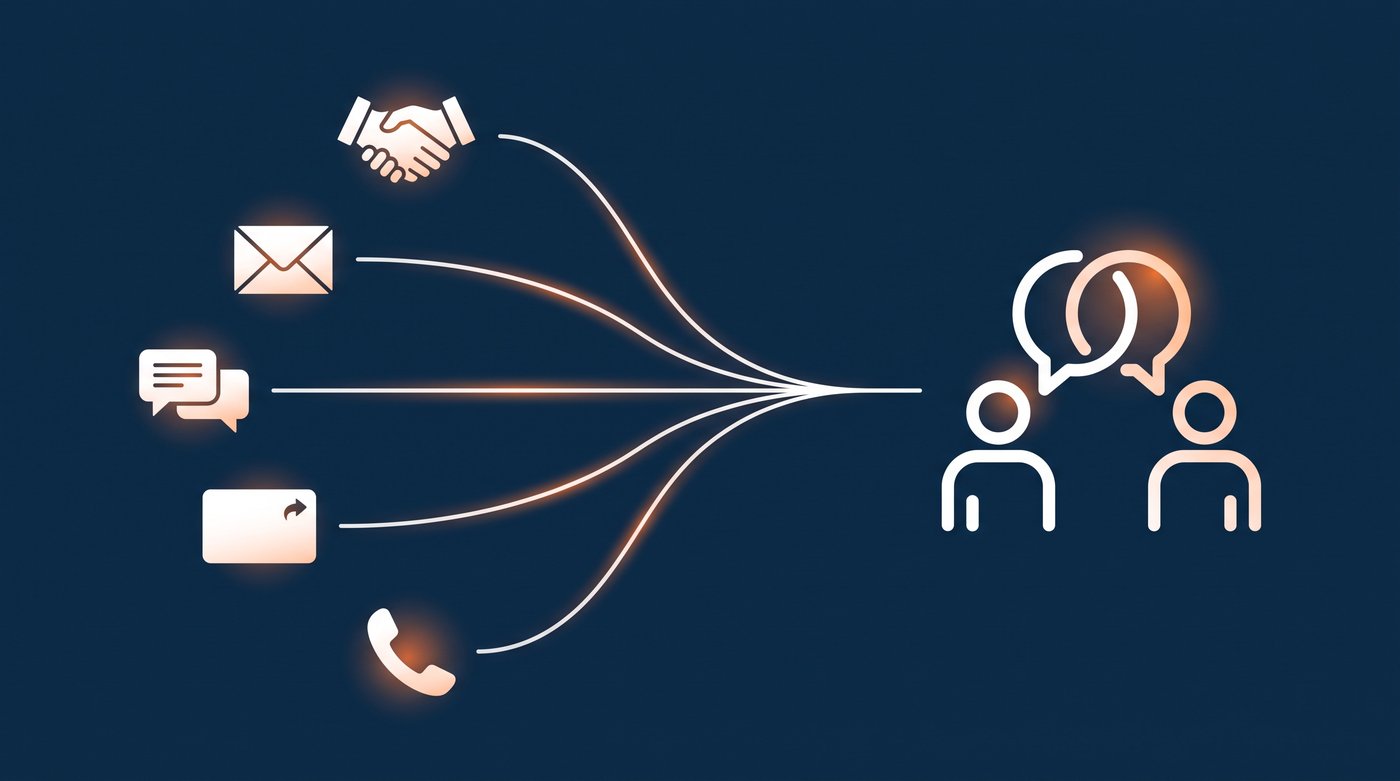
No single channel carries the whole sales approach. Referrals bring trust. Cold email gives reach. LinkedIn shows current conversations. Posts make your work easier to check. Calls turn interest into a real decision.
Use the source to choose the next move:
| What you know | Best first move | What to do |
|---|---|---|
| A trusted person knows the buyer | Ask for an introduction | Explain the problem you solve and why the match may make sense |
| The company fits and you have a checked email | Send a cold email | Give one real reason for writing and ask one simple question |
| The person posted or commented about the problem | Comment or send a LinkedIn message | Use what they said and continue that specific conversation |
| The buyer follows you but has shown no need | Keep posting useful work | Give them proof they can check before you contact them |
| The person replied or accepted an introduction | Book a short call | Understand the problem before you explain the whole service |
Start with referrals and old relationships
Past clients, partners, old colleagues, and people who know your work are the simplest place to start. Do not send a fake catch-up note. Tell them what you now help with and ask about one person or situation they may recognize.
Keep the request small:
Hey Sam, we are helping agencies fix leads getting lost between forms, email, and the CRM. You mentioned Northstar had that issue last year. Is it still a problem for them?
The message works because Sam can answer it. "Do you know anyone who needs automation?" makes Sam search their whole network and guess what counts.
Use cold email for reach
Cold email is useful when the company fits but you do not have a warm introduction or recent LinkedIn conversation. Build a narrow list, check each company, and write from a real fact. The goal is to connect with potential clients, not fill a sending tool.
The first email does not need your full story:
Subject: HubSpot handoffs at Northstar
Hey Maya, saw Northstar is hiring three client success people. Are new requests still assigned by hand, or did you already fix that?
We help service firms clean up that handoff. Happy to send the short process if useful.
The hiring fact gives a reason to ask. It does not prove there is a problem. That is why the email asks instead of announcing a diagnosis.
Follow up only when you can add something. A useful follow-up can share a relevant example, correct a bad assumption, or mention a new event. "Just checking this did not get buried" adds work for the reader and no value.
Use LinkedIn messages when the context lives on LinkedIn
A post or comment can show what the person is working on, what failed, or where they disagree. That makes a LinkedIn message feel like the next part of a conversation.
Keep it simple:
Hey Maya, saw your comment about tickets going to the wrong person after the HubSpot change. Is the problem the routing rule, or missing account data?
This message does not praise the comment or force a meeting. It uses the issue and asks a question Maya can answer quickly. The LinkedIn prospecting message templates article has more examples for posts, comments, referrals, and follow-ups.
Sometimes the better move is a useful comment. If a person has shared an idea but not a need, add a clear example or helpful disagreement where the conversation already exists. The LinkedIn comments method explains when to comment, message, research, or skip.
Post so buyers can check how you think
You do not need to become a full-time creator. Post from real work often enough that your profile does not look empty when a buyer checks it.
Useful posts can explain a mistake you found, a choice you made, or a result and what caused it. Remove private client details, but keep the problem and decision real. "Five tips for better automation" is easy to ignore. "Why we stopped syncing every form field into HubSpot" shows a judgment a buyer can test.
Reply to comments. Leave useful comments on posts your buyers already read. Posting supports direct contact instead of replacing it. A quiet founder with good proof and clear messages can still sell.
Build a simple weekly sales process
A good weekly process protects time for finding people, writing, calls, and learning. It also stops you changing the sales strategy after one quiet morning.
Here is a simple starting rhythm. Change the days, but keep the work separate.
| Part of the week | Main work | Output to keep |
|---|---|---|
| Start | Review referrals, target accounts, posts, comments, and company changes | A short list with the reason each person may matter |
| Middle | Send cold emails and LinkedIn messages, leave useful comments, make planned calls | The exact message, source, and reply |
| Throughout | Run client calls and send clear next steps | Buyer words, objections, decision, and next action |
| End | Review which sources produced useful conversations | One change to the buyer, message, offer, or source |
Do not judge the week by how many names you collected. Track useful replies, calls with a real problem, proposals, wins, and losses. Reply rate can be one metric, but a list of 500 contacts can still hide weak targeting. Five clear conversations can change the business.
Use one simple sheet or CRM. Give every person a source, a reason, a current state, and a next action. You should be able to answer: Where did this person come from? Why did we contact them? What did they say? What happens next?
Turn calls into a better offer
The call turns sales into useful market learning. Do not rush into a demo because the buyer agreed to meet or wants to jump on a call. First understand what is happening, why it matters, and what they already tried.
Ask simple questions:
- What is happening now?
- Where does it break?
- What have you tried?
- What does the problem cost in time, money, or missed work?
- Who else needs to be involved in a decision?
- What would a useful result look like?
Then explain only the part of your service that fits. A full tour often hides the connection between the buyer's problem and your work.
After the call, send a short note with the problem, agreed next step, owner, and date. If there is no next step, say so. Clear losses teach more than calls left in a vague "follow up later" state.
Review lost work once a month. Separate bad fit, no urgency, weak proof, unclear offer, price, and no decision. These reasons tell you what to change. A raw win rate does not.
Let tools handle research, not judgment
Sales tools can remove repeated work. They should not decide that every profile match deserves a message.
A contact database such as Apollo can find people by role, company, size, and industry. It helps when you need market coverage or checked contact data. It does not tell you which person is talking about the problem now. The Apollo comparison explains that difference.
Signado starts from current LinkedIn conversations. It watches LinkedIn posts and comments around chosen topics, creators, and competitors. It enriches the person and company, checks them against your client profile, keeps what they said, and gives a verdict such as message, comment, research, or skip.
That gives you a short list with the reason and next move already attached. Instead of opening profiles and comment sections each morning, you can spend that time writing to the best fits, adding useful comments, and talking to buyers. The warm leads page shows the full flow.
The source scoreboard shows which keywords, creators, and competitor audiences bring good-fit people and which bring noise. That lets you improve where your conversations start instead of blaming every weak reply on the message. Signado handles the repeated research. You keep the messages, calls, and choices that teach you how to sell.
Keep these parts for as long as they still teach you something:
- Choosing the buyer and problem
- Reading useful replies
- Running important calls
- Changing the offer, price, or proof
- Deciding why work was won or lost
Research, email finding, notes, reminders, and routine follow-up can move first. You keep the decisions. The admin moves away.
When should you hand off founder-led sales?
Before your first sales hire, make sure you can show another person what good looks like. You should know who buys, which problem starts a useful conversation, what proof works, how a strong call runs, and why recent clients chose you.
Look for these signs:
- The same kind of buyer keeps showing the same problem
- One or two sources produce most useful conversations
- Your message and call process work without changing every week
- The founder is delaying replies, proposals, or client work
- Another person can follow the process without hiding buyer feedback
Do not hand off because you dislike selling. If the offer is still unclear, a new hire inherits the confusion. HubSpot's guide to scaling founder-led sales makes the same point: build the process before you expect someone else to repeat it.
The handoff can happen in steps. Someone else can build lists, update records, and book calls while you still run discovery and close work. Later, they can lead routine calls while you join larger or unusual ones.
Stay close enough to hear changes in the market. Leading sales may stop being your daily job, but talking to buyers should not disappear from your week.
Common founder-led sales questions
How long should founder-led sales last?
There is no fixed month or client count. Keep leading it until the buyer, problem, message, call, and offer are repeatable enough to teach. Move admin earlier, but keep joining calls while the business is still learning.
Does founder-led sales work for service businesses?
Yes. It fits agencies and consultants because buyers often care about the founder's judgment and proof from similar work. You still need a narrow offer and a consistent process. Personal access cannot rescue a vague service.
Should a founder use cold email or LinkedIn?
Use both when the context supports both. Cold email gives reach across a checked market. LinkedIn is stronger when a post, comment, or shared contact gives you a natural opening. Do not copy the same note into both channels on the same day.
Do founders need a personal brand?
No. A clear profile, useful proof, and occasional posts are enough to support direct sales. A strong personal brand may create inbound interest, but you still need referrals, messages, calls, and follow-up.
How much time should a founder spend on sales?
Set a weekly block that is large enough to create conversations and small enough to protect delivery. The exact number depends on deal size, sales cycle, and current demand. Track whether the block produces useful replies and calls. Add time only when the source and message are already working.
Start with one week, not a perfect system
Pick one buyer, one problem, and two sources. Ask for a few specific introductions. Send cold emails to checked companies. Review relevant LinkedIn posts and comments, then message, comment, research, or skip based on what is actually there.
At the end of the week, read the replies and call notes. Change one thing. Stay close enough to buyers to learn while you build a process another person can repeat later.
If LinkedIn research is the part taking your morning, see how Signado finds and sorts warm leads from the conversations already happening in your market.
Land your next client with something relevant to say
Signado finds the people already talking about what you do on LinkedIn, and shows you what they actually said. You reach out with a reason they'll recognize.