
TLDR: Most consulting work comes from people who already know you. So start there every week: past clients, old colleagues and firms that serve your buyers. When referrals slow, find people talking on LinkedIn about the problem you solve. Show proof before you ask for a call, and count what works.
Here's the short answer. When you plan how to get consulting clients, start with the people who already know your work. In a survey of independent consultants by Saidin Strategies, about 80% of client projects came from personal networks. Then add one outbound channel you control, like LinkedIn conversations about the problem you solve.
You need that second channel because referrals are slowing. The RSW/B2B 2026 Professional Services New Business Report surveyed small and mid-sized firms in the US and Canada. Most had 1 to 100 employees. 48% said winning new business got harder than in 2025. Over half said referral business slowed. Only 4% said it went up.
This guide shows independent consultants and small consulting firms how to find consulting clients, channel by channel. Running an agency? Our guide for B2B service businesses covers more ways to get clients. Selling SEO? Read how to get SEO clients.
How do consultants get clients?
Most consulting work comes through people who already trust you: past clients, former colleagues and the people they refer. Partners who serve the same buyers come next. To reach new people, join LinkedIn conversations where buyers describe the problem you solve. Talks and writing build trust more slowly. Cold outreach works only with a clear reason.
In the Saidin survey, consultants rated personal relationships and word of mouth as most effective. Partnerships with other consultants came second.
Start with your ideal client and one problem
"I help businesses grow" is too broad. It can't guide a search, a post or a referral. A clear picture of your ideal client lets someone else spot a buyer for you.
Write down four things:
- The kind of company you help
- The person closest to the problem
- The problem you solve
- The result or proof you can point to
For example, an operations consultant might help owner-led manufacturers with 5 to 50 employees fix slow quoting. A marketing consultant might help B2B software companies lower paid ad costs after a product launch. IT and AI consultants can be just as narrow. Think of an AI consultant who helps small accounting firms sort client documents faster.
Each part is specific enough to check against a real company. Being that specific also makes referrals easier. A former client may not know anyone who needs "business consulting." But they may know a manufacturer whose quotes take a week.
This is your ideal client profile, or ICP.
Ask the people who already know your work
Your network is the best place to start if you've done good work and kept in touch. And it brings in more new work than it did a year ago.
RSW/B2B asked firms what was working to win new business. 52% named existing clients, up from 27% the year before. 44% named referrals, down from 76%. In the Saidin survey, 40% of projects led to more work with the same client.
What to do this week:
- Scroll your 1st-degree LinkedIn connections, the people you're directly connected to. Write to past contacts in a way that fits the relationship. It isn't cold outreach, so don't make it read like it.
- Find past clients who moved to a new company. They know your work and may be able to bring you in again.
- List the companies where you finished second after a pitch. A few months later, the firm they chose may not be working out. Send a short case study or a useful idea.
- Ask one happy client for an introduction by name. Give them a short note they can forward.
The first three come straight from the RSW/B2B report. It suggests 30 minutes to an hour a day for the first one. Don't hide a pitch inside a fake catch-up, though.
Then count the replies, introductions and calls from each group. If people reply but nobody introduces anyone, your ask is too vague. Name the kind of company you want.
When should you skip this channel? Never. Just don't make it your only one, because you can't plan a month around referrals.
Partner with firms that serve your clients
Partners work best when another firm serves the same clients just before or after you. A fractional CFO (a part-time finance lead) shares clients with bookkeeping firms. An operations consultant shares them with the firm that sets up the client's software. Both firms keep meeting buyers the other could help.
Keep it personal. Formal referral programs ranked among the lowest in the Saidin survey. A partner who knows your work beats a form on a partner page.
What to do this week:
- Write down the firms your clients already use for related work. An IT consultant might pick software resellers. An AI consultant might pick a development shop that builds what you recommend.
- Choose two and help them first. A fractional CFO might send a bookkeeping firm a referral, or run a cash flow session for its clients.
- Agree which clients you'll send each other, and how fast you'll follow up on an introduction.
Every quarter, check how many introductions each partner sent. One active partner beats a long list.
No firm comes to mind whose clients need you? Then skip partners for now. And avoid any partner who sells part of what you do. You'd end up competing for the same projects.
How to get consulting clients on LinkedIn
Use LinkedIn if your buyers post, comment or read there. It's lead generation for consultants that doesn't wait for a referral.
Start with your profile, because a buyer will check it before replying. Put the client and the result in your headline. "Operations consultant" is a label. "I help small manufacturers shorten quoting delays" tells a buyer right away if you can help them.
Use the first lines of your About section to name the problem in the buyer's words. Add a case study or a client testimonial to your profile's Featured section, which LinkedIn places just above your Activity section.
Then pick where to look:
| Source | What to look for | Use it when |
|---|---|---|
| LinkedIn search | The right role, company size, industry and location | You need to map potential clients |
| Posts and comments | Someone describing a problem, a failed attempt or a question | You need a reason to write now |
| Creator or competitor audiences | Buyers commenting on posts by a competitor or a person your market follows | Keyword searches attract peers or vendors |
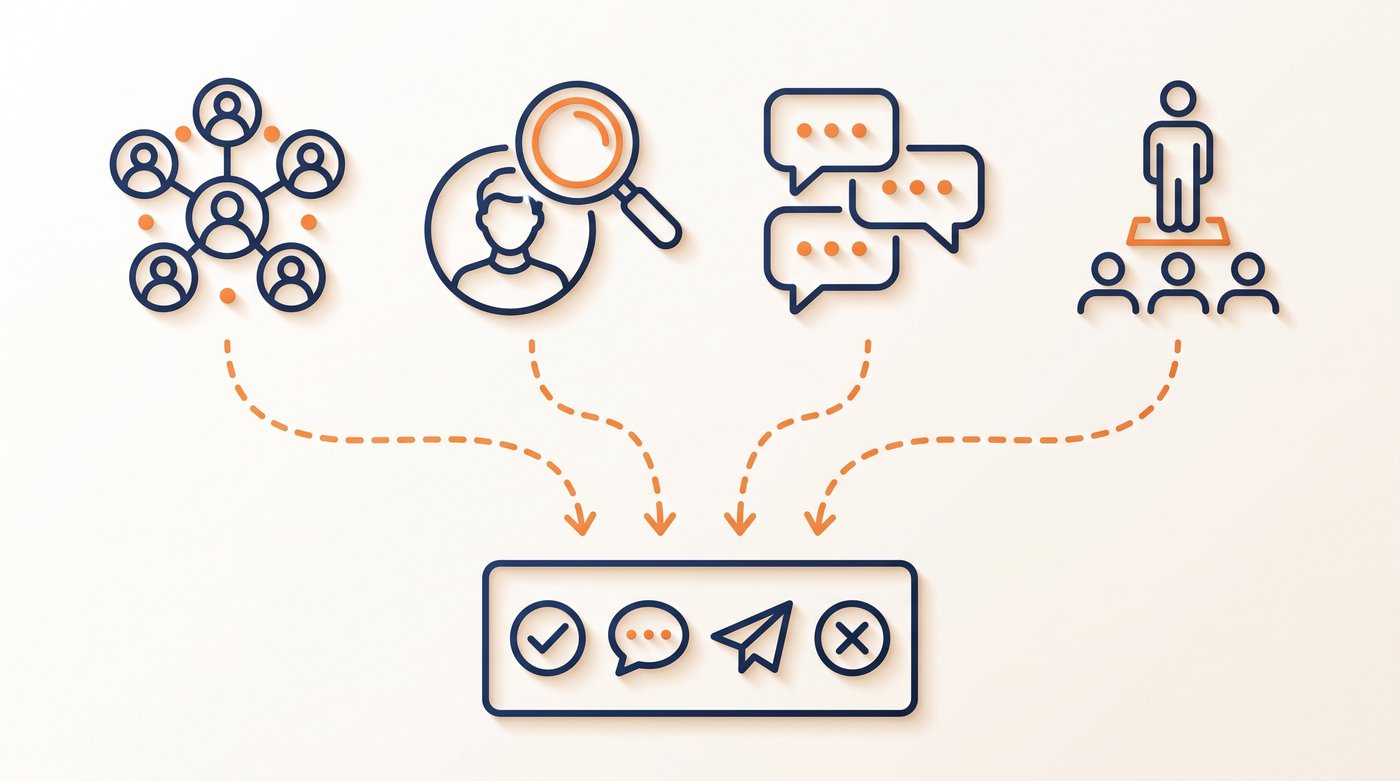
Posts and comments give you the reason to write. Search the words buyers use when they complain, not your service name. The LinkedIn comments method shows the full process.
Creator audiences help when keywords bring the wrong crowd. A creator audience is the people who comment on one creator's posts. Take a test for a consultancy in Canada that wanted owners of small manufacturers. Keyword searches kept bringing consultants and vendors.
A manufacturing founder's audience brought 37 people, and five were worth reviewing. One was a supply chain director who wrote that the business wasn't profitable enough yet. That gave the consultancy a real problem to ask about.
Before you write, check four things:
- Does the company match the size, market and location you serve?
- Is the person close to the problem or the decision?
- Did they say something tied to that problem?
- Do you have proof that fits their situation?
Then choose a comment or a message. Comment when you can add a detail from your own work:
We saw the same delay when approvals moved between sales and operations. The fix was giving one person ownership of the handoff. Is ownership or missing information the bigger issue for you?
Message when the person named a problem or asked a question:
Your comment about quotes taking a week stood out. I've seen the delay come from product rules as often as the quoting tool. Is the team waiting on technical input, pricing approval or both?
Neither one pitches. Both show why you wrote, and both are easy to answer. For more examples, see our messages that get replies.
This week, fix your headline and pick one source. Write to the few people who pass all four checks. Then count replies and calls by source. If keywords and creator audiences both keep turning up peers and vendors, skip LinkedIn for now. Put that time into referrals and partners.
Speak and write where your buyers learn
Talks, webinars and content marketing work when your buyers learn at events, in newsletters or in industry groups. They're slow. But buyers start coming to you, and they trust you before the first call.
Events still bring work. In the RSW/B2B report, 40% of firms said networking was working, up from 34% the year before. Alastair McDermott of The Recognized Authority surveyed over 1,000 consultants. In his 2020 write-up, in-person networking at events was their number two source of new business.
What to do this week:
- Pick one event, group or newsletter where your buyers go, not your peers.
- Offer one talk, webinar or article on a question buyers ask before they hire you.
- Before an event, check who's going and pick a few people to meet. Follow up that week and mention what you talked about.
Then ask every new lead how they found you. Count the talks and posts they name, not likes or business cards.
Skip rooms full of consultants who sell what you sell. They're good for learning but rarely bring clients. And don't count on content alone if you need a new client this month.
Use proof before you ask for a call
Consulting clients buy judgment. Show them how you think before you ask for their time.
Proof can be a case study, a clear result, a client testimonial or a short post that explains a decision. The best ones name the starting problem, what you changed and what happened. "Helped a client improve operations" says almost nothing.
Match the proof to the person. A small services firm may care about speed and owner time. A larger company may care about risk, and whether the change works across several teams.
Ask for a call once the person shows interest, or once the problem is clear enough to discuss. A useful back-and-forth counts as progress, even without a call. Don't push a calendar link in every message.
A weekly routine to get consulting clients
Keep it small enough to repeat when client work is busy:
- Contact one or two past clients, former colleagues or partners.
- Review one LinkedIn source, like a saved search, a creator or a keyword.
- Check each person and company against your ideal client profile. Mark the next move: comment, message, wait or skip.
- Follow up on open conversations where you have something useful to add.
- Share one piece of proof, like a post or a short case study.
- At the end of the week, record replies, calls and new clients by channel and source.
Then look at your sources. If one creator audience keeps bringing owners in your market, keep it. If a keyword brings mostly other consultants, change it. Better copy won't fix the wrong people.
Change one thing at a time, or you won't know what worked.
When finding the conversations takes too long
Reading LinkedIn conversations by hand works for a short list. It gets slow once you follow several keywords, creators and competitors. You open comment sections and check each person and company. Then you note what each one said, since that's your reason to write.
Signado can run that search for you. It finds people on LinkedIn who post and comment about the problem your consulting work fixes. You decide where it looks: keywords, creators, competitors or a single post. It saves what each person wrote, and it never connects to your LinkedIn account. Every person, and their company, gets compared with your client profile.
Next to each name you get a score for how well they match your business, and a short reason for it. Signado also names the next move. It may be to contact them now, comment on the post, wait for their next post, or skip. If a message is the right move, Signado can draft the first one from that person's own words. You review the draft, change what you like and send it yourself.
You stop hunting through comment threads between client calls. Each week starts with a short list of warm leads and the reason to contact each one. That's how we ran our LinkedIn comments field test. Picking people by job title and company got 25 replies from 139 messages, or 18.0%. Starting from a recent post or comment got 78 replies from 149, or 52.3%. And 25 of those 78 replies turned into product demos.
Common questions
Should consultants send cold messages on LinkedIn?
Only when you can say why that person should get it now. Try this test: remove the person's name and company from your draft. If it would still work for anyone with that title, it's too generic to send. Consultants in the Saidin survey ranked cold outreach among the least effective ways to find clients.
Do consultants need LinkedIn Sales Navigator?
No. Free LinkedIn search is enough to test whether your buyers talk there. Sales Navigator is LinkedIn's paid upgrade for search, with deeper filters, saved searches and alerts. One of its filters shows people who posted in the last 30 days. It won't search posts and comments for the problem you solve, though. Pay for it when rebuilding the same searches wastes your time, or when free filters can't narrow down your market. For a walkthrough, see our Sales Navigator guide.
Do online platforms work for finding consulting clients?
They can bring small projects with a clear scope. But buyers there compare providers side by side, so price comes up early. Online platforms also ranked near the bottom of the Saidin survey. Use them as a side channel, not your main one.
How should consultants track where clients come from?
Keep one row per person. Note where they first came across you and what led to the call. They often differ: a post may start it and a referral may close it. Count a reply as useful only when it answers your question or moves the problem forward. A polite thanks doesn't count.
Find one useful conversation this week
Choose one type of buyer and one problem. Write to one past client or former colleague today. Then find a recent LinkedIn post or comment about that problem. Check the person and the company, and send one short question about what they said.
Want Signado to find those conversations for you? Start with one LinkedIn source.
Get clients
Where agencies and consultants find clients, and how to start a conversation that gets a reply.
Start with the client guideFounder Led Sales: How to Win Clients Yourself
Build a founder led sales system using referrals, cold email, LinkedIn messages, useful posts, calls, and simple follow-up.
Read articleHow to Use LinkedIn Sales Navigator for Lead Generation
Use LinkedIn Sales Navigator to find the right accounts and people, save searches, read alerts, check fit, and decide who is worth contacting.
Read articleLinkedIn Outreach Messages That Get Replies From Potential Clients
LinkedIn outreach messages potential clients reply to: templates for each situation, connection notes, LinkedIn's note limits and our own reply test.
Read articleLand your next client with something relevant to say
Signado finds the people already talking about what you do on LinkedIn, and shows you what they actually said. You reach out with a reason they'll recognize.