
The best cold email follow-ups don't follow a calendar. They follow signals. When you reference a funding round, a new hire, or a product launch at the prospect's company, you give them a reason to reply that "just checking in" never will.
Most reps don't do this. According to Woodpecker's outbound analysis, 70% of cold email threads die after one message. The reps who do follow up mostly send the same thing — "bumping this to the top of your inbox," "did you get a chance to look at my last email" — which gives the prospect zero new information.
The gap isn't persistence. It's relevance. This guide covers the timing, templates, and frameworks that turn follow-ups from noise into conversations.
What you'll learn
- Why most follow-ups fail
- When to send a follow-up
- How many follow-ups to send
- How to write follow-ups that work
- 5 follow-up templates
- How to automate follow-ups
- FAQ
Why most cold email follow-ups fail (and it's not your copy)
The "just checking in" problem
Sales teams spend hours crafting their first cold email. Subject line A/B tests, personalized openers, value propositions tied to specific pain points. Then the follow-up shows up three days later with "just checking in" and undoes all of it. The average salesperson sends five follow-ups with zero new information in any of them.
The problem isn't laziness. It's that most follow-up sequences are built on a timer, not on information. Your sequence tool fires email #2 on day 3, email #3 on day 7, and email #4 on day 14, regardless of what's happening at the prospect's company. The rep has nothing new to say because they have no new reason to reach out. So they default to the nudge.
Cold prospects don't ignore your follow-up because they forgot. They ignore it because you gave them no new reason to respond. The first email didn't land, and the second email said the same thing in fewer words.
What the response rate data actually says
Sales.co analyzed over 2 million cold emails and found the average reply rate is 2.09%. Only 14.1% of those replies are positive. Follow-up emails specifically generated 20.6% of all replies, at a reply rate of 1.22%.
That means follow-ups do work, but they're pulling their weight with worse efficiency than the initial send. Why? Because most follow-ups don't add value. They remind instead of selling.
The data also shows cold emails fail at a higher rate when follow-ups are generic. Snov.io's data shows a 2-email sequence achieves a 6.9% response rate. Industry benchmarks for B2B SaaS cold email outreach sit around 3.7% reply rate with roughly 1.0% meeting rate. These aren't encouraging numbers, but they're the baseline that signal-based timing can beat.
When should you send a follow-up email?
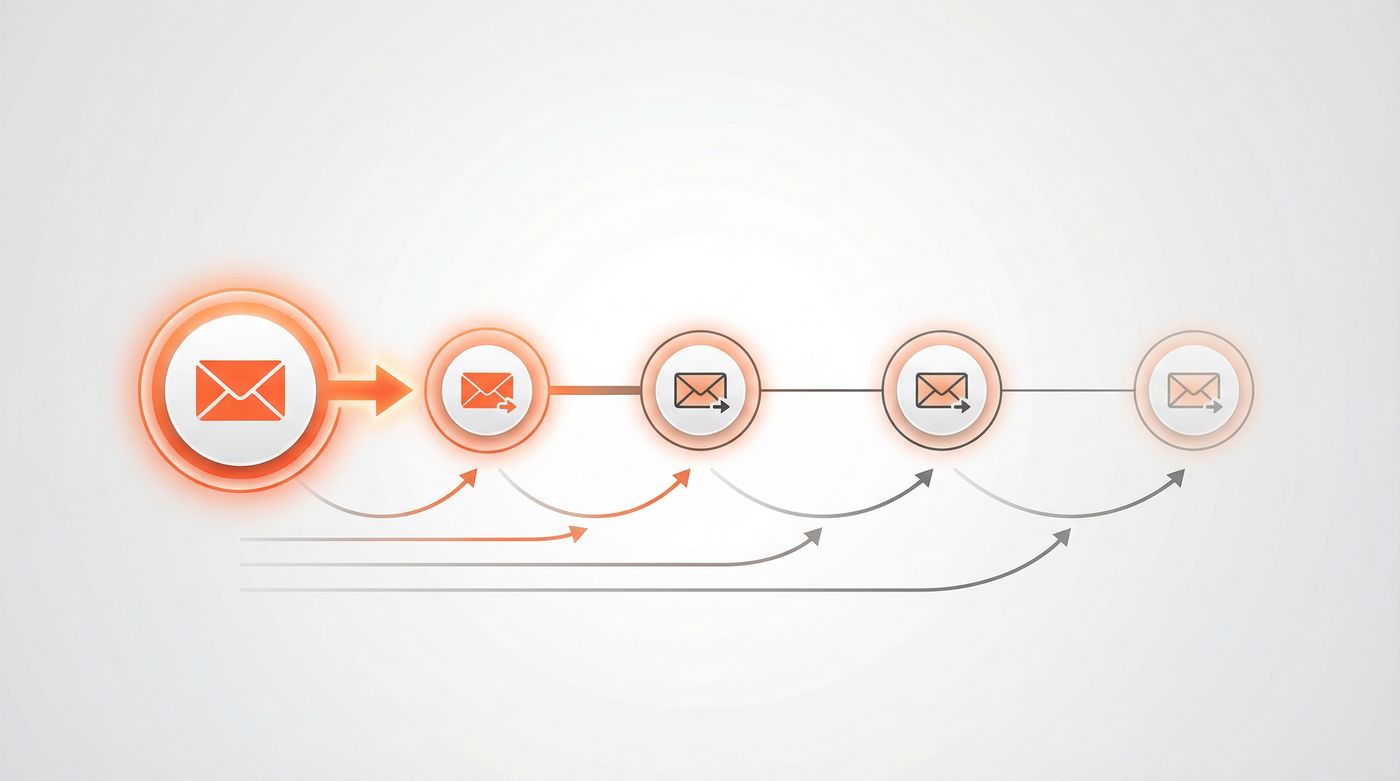
Three to five business days after your initial email is the standard baseline. But the best time to send a follow-up isn't dictated by a calendar — it's dictated by what's happening at the prospect's company. A funding round, a new executive hire, or a hiring spree gives you something relevant to say instead of "circling back."
Calendar-based timing (the 3-day rule)
The conventional wisdom: wait 3 business days after your first email, then follow up. Industry benchmark data from 2026 adds nuance: Wednesday tends to drive the highest reply rates (around 5.8% in some studies), and emails sent between 8-10am local time perform best.
Calendar-based timing is better than no timing at all. It prevents you from following up too soon (which feels pushy) or too late (which loses the thread). But it has a fundamental flaw: it assumes the prospect's readiness is a function of time, not circumstances.
A follow-up sent on Tuesday because your sequence says "day 3" might land perfectly. Or it might land the day after their company froze vendor budgets. Calendar timing ignores everything happening outside your email tool.
Signal-based timing (the better approach)
Signal-based timing means following up when something changes at the prospect's company. Not on a schedule, but in response to a sales trigger event that gives you a reason to reach out.
A prospect's company announces a $30M Series B. You follow up referencing the funding and how post-funding teams typically need your solution. That's not "bumping this." That's "I noticed something relevant to your situation."
Tools like Signado monitor seven trigger types — hiring, funding, leadership changes, news, partnerships, product launches, and executive LinkedIn activity — and surface them as they happen. The follow-up writes itself when you already know what changed. For the full tool landscape in this space, see our 10 best B2B sales intelligence tools breakdown.
This principle applies across the entire outreach process, but follow-ups are where it creates the most obvious lift. The practical guide to getting clients from LinkedIn shows how service founders can start with a relevant conversation instead of another scheduled touch. Your initial email is already personalized. Your follow-up is where generic copy usually returns. Context fixes that gap.
Not every signal makes the prospect ready for a follow-up. Use the warm lead definition to separate real context from light engagement before adding someone to an active sequence.
How many follow-up emails should you send?
Between four and seven total touches in a sequence. The first follow-up generates the highest marginal response rate. Each additional email after that adds less, with replies dropping sharply after touch five. Stop when the cost of another send, including reputation risk and time, outweighs the expected return.
The diminishing returns curve
Woodpecker's data confirms what most sales professionals already sense: 70% of email threads stop after one attempt. The reps who do persist see diminishing returns on each additional touch.
According to Snov.io, a 2-email sequence (one initial email plus one follow-up) achieves a 6.9% response rate. Adding a second follow-up improves things, but the jump from email 3 to email 4 is smaller. By email 6 or 7, you're sending into territory where most potential customers who would respond already have.
The math is straightforward: if your first follow-up generates the bulk of incremental replies, that's where your email copy, timing, and personalization matter most. By the third follow-up, you should be switching angles entirely — different pain point, different format, or a trigger event that changes the conversation.
Structuring your follow-up sequence
A follow-up sequence should have escalating value, not escalating pressure. Each email needs a different angle. Here's a structure that works:
| Touch | Timing | Purpose | CTA |
|---|---|---|---|
| 1 (Initial) | Day 0 | State the value proposition, reference a specific pain point | Soft ask (reply or quick question) |
| 2 (First follow-up) | Day 3-5 or signal trigger | Reference original email + add new value | Same soft ask |
| 3 | Day 7-10 or signal trigger | Social proof or new resource | Meeting link or specific date |
| 4 | Day 14 or signal trigger | Different angle on the same problem | Direct ask |
| 5 | Day 21 | Breakup email | Permission-based close |
Teams using signal monitoring tools build this differently. Instead of fixed intervals, they set daily monitoring for high-priority accounts and weekly for secondary targets. When a trigger fires on day 6 instead of day 7, the follow-up goes out with a real reason attached.
How to write a cold email follow-up that gets replies
Most guides on how to write a follow-up email focus on word choice. The real leverage is structure: treat each follow-up as a separate conversation, not a repeat of your opener.
Reference the original context
Your follow-up isn't a standalone message. It's the continuation of a conversation you started. Reference your previous email in one sentence, then move forward. Don't rehash your entire pitch.
Bad: "I emailed you last week about how we help companies improve their outbound process using our platform that monitors buying signals and generates AI-powered outreach..."
Good: "I reached out last Tuesday about reducing your ramp time for new AEs. Since then, I noticed your team posted four new SDR roles."
One sentence of context. One sentence of something new. That's the structure that earns a reply.
Add new value (not "bumping this")
Every email in your sequence should give the prospect additional value and information they didn't have before. A case study relevant to their industry. A data point about their competitor. A buying signal from their own company that creates urgency.
The value doesn't have to be a white paper or a 30-page report. It can be a single stat, a relevant article, or an observation about their business. What matters is that the prospect learns something by reading your follow-up that they wouldn't know if they hadn't opened it.
If you remove your product pitch and the email still has value, you've written a good follow-up. If it collapses into nothing without the pitch, it's a sales email disguised as a follow-up.
Make it easy to respond
Long follow-ups with open-ended questions get ignored. Short follow-ups with a specific call to action get responses.
Instead of "Would you be open to discussing how we might be able to help?", try "Do you have 15 minutes Thursday afternoon?" Instead of "Let me know your thoughts", try "Is this on your radar for Q2? A yes or no is fine."
The easier you make it to respond, the more responses you'll get. A question that requires a paragraph loses to a question that requires one word.
Subject lines that get opened
Backlinko's email outreach study found personalized subject lines increase response rates by 30.5%. The same study found longer subject lines (36-50 characters) achieve 24.6% higher response rates than short ones. For a deeper breakdown of what works (and what tanks open rates), see our guide to cold email subject lines.
For follow-ups, your subject line strategy depends on whether you're replying in the same thread or starting a new one. Same-thread replies inherit the original subject line, which maintains context. New threads need a subject line that stands on its own.
Follow-up subject lines that work tend to reference something specific: the prospect's company name, a recent event, or the topic of your initial email. "Re: SDR hiring at [company name]" beats "Following up" every time. Specificity signals that this isn't a mass send.
5 cold email follow-up templates that work
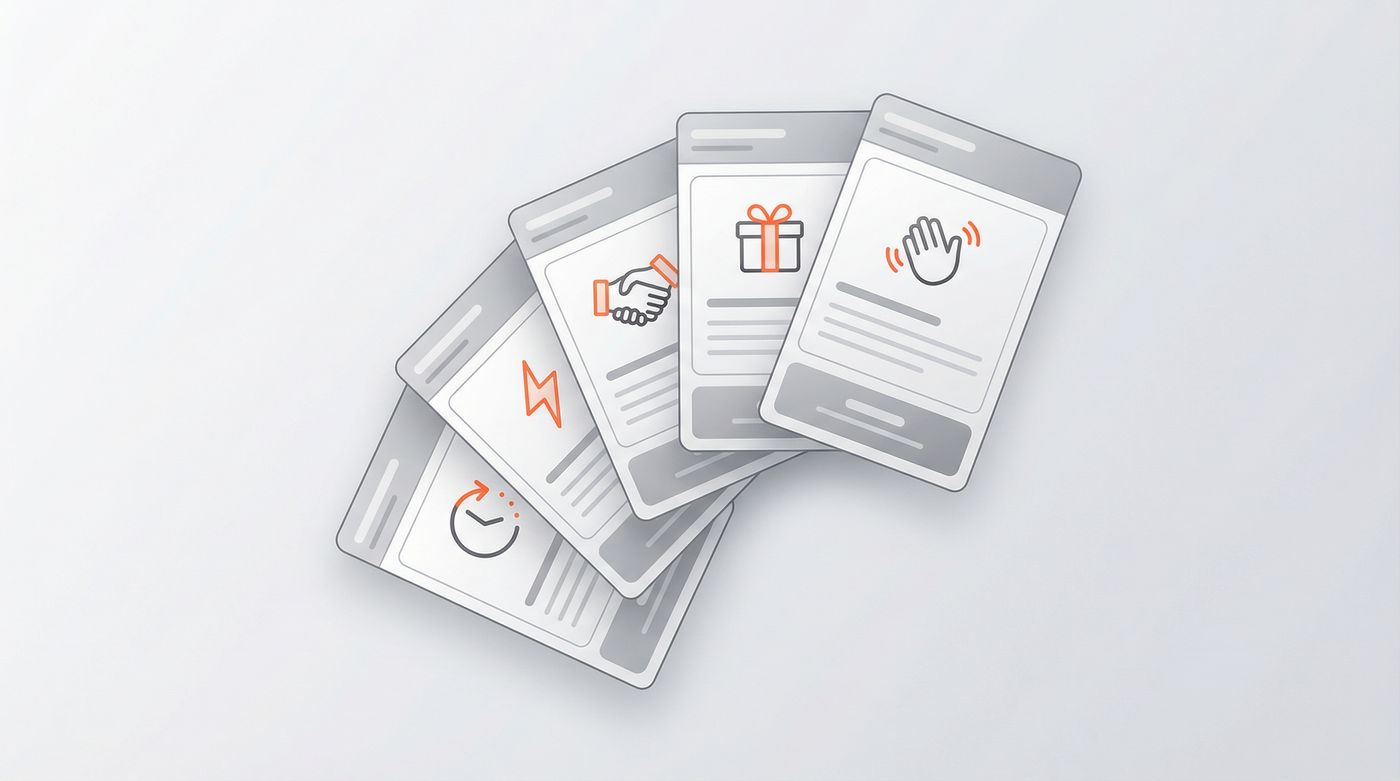
These templates are starting points. Adapt them to your industry, prospect, and whatever signal triggered the follow-up. Templates work best when personalized with real company data — a follow-up email template is only as good as the context behind it. For the initial outreach that precedes these follow-ups, see our cold email templates guide.
The signal-based follow-up (trigger event)
This is the highest-performing follow-up type because it gives the prospect a concrete reason to engage now. A trigger event at their company creates urgency that calendar-based timing can't manufacture.
Subject: [Company name]'s [funding round / hire / product launch]
Hi [First name],
I reached out [last week / on date] about [one-line summary of original email].
Congrats on the [specific trigger, e.g., Series B announcement / new VP of Sales hire / product launch]. Companies at this stage typically [specific challenge that your solution addresses].
[One sentence about how you've helped a similar company in this situation].
Worth a 15-minute call to see if this is relevant? [Specific date/time].
This template works because it proves you're paying attention. The prospect knows this isn't a mass send because it references something that happened at their company this week.
For the Series B funding round playbook, that 2-8 week post-funding window is where buying decisions happen fastest. Your follow-up should land inside that window, not three months later.
Signal monitoring tools solve this by stacking signals into a single feed per account. Your CRM shows the case study download. LinkedIn shows the new CRO. Crunchbase shows the funding. Instead of checking three platforms, you see the full picture and reference all of it in one follow-up.
The value-add follow-up (new resource/data)
When you don't have a trigger event, give the prospect something useful. Not your product brochure. A data point, a resource, or an insight relevant to their pain point. Most follow-ups that don't get responses fail because they don't offer anything the prospect didn't already know.
Subject: [Stat or resource] for [their role / company]
Hi [First name],
Following up on my email from [date]. I came across [specific stat, article, or resource] that's relevant to [their challenge].
[One sentence explaining why it matters to them specifically].
[Link to resource if applicable].
Is [specific challenge] something your team is looking at this quarter?
The bar: could this email work as a value-add even if you never wanted a meeting? If yes, it's a strong follow-up.
The social proof follow-up
Social proof works because it shifts the conversation from "trust me" to "here's someone like you who got results." Specificity matters. "We helped a SaaS company" is weaker than "we helped a 200-person fintech company cut prospecting time by 40%."
Subject: How [similar company] handled [same challenge]
Hi [First name],
I reached out last [day] about [topic]. Wanted to share a quick result.
[Similar company in their industry] was dealing with [same challenge]. After [what happened], they saw [specific, measurable result].
Your team at [company] seems to be in a similar spot with [specific observation]. Happy to share what worked for [similar company] if it's useful.
15 minutes this week?
The breakup email
The breakup email is your last touch. It works because it gives the prospect explicit permission to say no, which paradoxically makes them more likely to respond. When you don't hear back after multiple attempts, this is where you stop following up—but on their terms, not silently.
Subject: Should I close this out?
Hi [First name],
I've sent a few messages and haven't heard back, so I'll assume the timing isn't right.
I'll close this thread out on my end. If [specific challenge] becomes a priority down the road, here's my calendar link: [link].
No hard feelings either way.
Keep it short. No guilt trips, no passive aggression. Don't write "I think you missed my email" — they didn't miss your email, they chose not to reply. The breakup email that actually works is the one that genuinely makes it easy to respond with "no" or "not now, but maybe later."
The "easy yes" follow-up
This sales follow-up email asks for the smallest possible commitment. Not a demo. Not a 30-minute call. Something that takes less effort to accept than to decline.
Subject: Quick question on [their challenge]
Hi [First name],
One question: is [specific challenge, e.g., ramping new SDRs faster] something you're actively working on at [company], or is it on the back burner?
Either way is helpful to know.
A yes/no question gets more replies than an open-ended one. The prospect's path of least resistance should be to respond, not to ignore.
How to automate your follow-up sequence
Sequence tools and where they fall short
Email campaigns built in tools like Instantly, Smartlead, or Lemlist follow a fixed schedule. You set the delay between emails, write your templates, and the tool sends them on autopilot. For sales campaigns at scale, this handles the mechanics — you can send follow-up emails and send emails consistently without manual tracking. Most reps who wanted to follow up with every prospect rely on these tools, and they're better than doing nothing. One caveat: all of these assume your sending domain is already warm. If you're starting from zero, see our email warm-up tool comparison first — a cold domain will land your follow-ups in spam regardless of how good the sequence is.
The gap is timing intelligence. A sequence tool doesn't know that your prospect's company just hired a new CRO or closed a funding round. It sends email #3 on day 7 because the calendar says so, regardless of what's happening at the account. The automation handles delivery. It doesn't handle relevance.
Signal-based automation
Signal-based automation works differently. Instead of scheduling follow-ups on a fixed timeline, it monitors your target accounts for trigger events and tells you when to send your follow-up — and what to say in it.
Signado, for example, runs two monitoring cadences: daily monitoring that checks your highest-value accounts daily, and weekly monitoring that checks your broader list weekly. When a signal fires, the system generates a personalized outreach draft referencing the specific trigger and company context. Your rep reviews and sends instead of researching from scratch.
For accounts that have gone cold, dormant lead reactivation is where signal monitoring pays off most. A prospect who ignored your first sequence six months ago might respond today because their company just launched a new product line and needs vendor support. Your email tool sees an old, cold lead. A signal tool sees a buying window.
The difference between automate-and-forget and automate-with-intelligence is the difference between many follow-ups and relevant follow-ups.
FAQ
How many emails should you send before giving up?
Three emails is the minimum before writing off a cold prospect, but treat it as a floor, not a formula. Each email has to earn the next one by adding a new angle, resource, or reference to something that changed at their company. Enterprise prospects with longer buying cycles often need five to seven touches, while SMB targets move faster and may only warrant three to four. If your third email says the same thing as your second, it's not persistence, it's noise.
How long should a follow-up email be?
Under 125 words. Follow-ups are shorter than initial emails because the context exists. One sentence referencing the last email or trigger event. One sentence adding new value. One clear call to action. If a follow-up takes more than 15 seconds to read, it's too long. Your prospect decided to open it. Don't punish them with a wall of text.
Cold email follow-up strategy comes down to one question: does your next email give the prospect a new reason to reply, or are you just reminding them you exist?
Calendar-based sequences get you part of the way. They enforce consistency and prevent leads from falling through cracks. But the follow-up that actually books the meeting is the one that arrives when something relevant happens at the prospect's company, references it specifically, and makes responding easy.
Start with a structured sequence of four to five touches. Add signal-based triggers for your highest-priority accounts. Replace "just checking in" with "I noticed [specific event]." Your response rate will reflect the shift.
If you want to automate the signal monitoring and outreach generation, that's what Signado does. Import your list, set your monitoring cadence, and let the system surface the timing and context so your reps focus on selling, not researching. See the use cases to find the playbook that fits your outbound motion.
Land your next client with something relevant to say
Signado finds the people already talking about what you do on LinkedIn, and shows you what they actually said. You reach out with a reason they'll recognize.