
The best cold email templates don't read like templates. They read like a message from someone who did ten minutes of research and wrote something specific. The email writing matters less than you think. The timing matters more than anyone admits.
Across 2 million+ cold emails, Sales.co measured an average reply rate of 2.09%, with only 0.64% converting to genuine interest (Sales.co, 2026). That's the baseline when you fill in blanks and hit send on autopilot. But Autobound's 2026 research found that signal-based personalization, where the email references a real trigger event at the prospect's company, pushes reply rates to 15-25% (Autobound, 2026). Same inbox. Same buyer. Different approach.
The gap isn't about writing better email copy. It's about matching the right template to the right moment. A funding-round template sent three days after the announcement performs. The same template sent six weeks later doesn't. This guide gives you 15+ cold email templates for sales organized by trigger, a framework for structuring every sales email you write, and the personalization system that separates mass cold email outreach from targeted conversations.
What you'll learn
- What makes a cold email template actually work
- How to structure a cold email
- 15+ cold email templates for B2B sales
- The best cold email format for B2B
- Cold email frameworks top reps use
- How to personalize templates without it taking forever
- Cold email mistakes that kill reply rates
- FAQ
What makes a cold email template actually work?
The template paradox: why most templates produce template-sounding emails
Every sales blog publishes "the 10 best cold email templates." Sales teams copy them. Prospects get the same email from twelve vendors in the same quarter. The template stops working the moment it becomes popular.
This is the template paradox. Cold emailing at scale means everyone gets the same "personalized" message. A cold email template is a framework, not a script. The moment you use it word-for-word, you sound like everyone else who downloaded the same PDF. Lemlist publishes 21 templates with placeholders like {firstName} and {trigger}. Thousands of reps fill in those brackets with the same surface-level details. The prospect sees "Hi Sarah, I noticed your company recently..." for the fifth time this week and hits delete.
Templates that produce replies do something different. They give you a structure (observation, problem, proof, ask) and force you to fill the structure with research that can't be faked. A template that says "Reference a recent hire in their department" only works if you actually found the hire, know why it matters, and connect it to a problem your product or service solves. The structure is reusable. The content inside it shouldn't be.
The three variables that predict replies (timing, relevance, friction)
Timing is the variable most cold emailing advice ignores. Your sequence tool says "send email 1 on day 0, follow-up on day 3, break up on day 7." That schedule has nothing to do with the prospect's buying window. A VP of Engineering who just posted three open roles for backend developers is in a buying window for developer tools right now. Sending that email in two weeks because your cadence scheduled it there means missing the window.
Relevance separates a 2% reply rate from a 15% reply rate. Sales.co's data shows the average cold email gets a 2.09% reply rate (Sales.co, 2026). Autobound's research on signal-based personalization shows 15-25% when the email connects to a real event (Autobound, 2026). The difference is whether the prospect reads the email and thinks "this could be about anyone" or "this is about something I'm dealing with right now."
Friction is what you're asking for. A "quick 15-minute call" is not low friction for someone who gets 40 cold emails a day. "Would it be worth a 10-minute conversation if I could show you how [specific company] solved [specific problem]?" gives the prospect a reason to say yes. The ask needs to match the relationship, which at this point is zero.
How should you structure a sales email for cold outreach?
Four sentences. That's it. An observation about their company, the problem it implies, proof you've solved it before, and one low-friction ask. Keep it short — every cold email that consistently gets replies follows this structure, regardless of industry, deal size, or whether you're emailing a CRO or an engineering manager.
Observation, problem, proof, ask (the core framework)
Sentence one: something you observed about their company that they know is true. "I saw you opened 5 AE roles this quarter" or "Noticed your team just launched the enterprise tier." This isn't small talk. It's proof you've done your research, and it earns you the next sentence.
Sentence two: the problem that observation implies. "Scaling from 5 to 10 AEs usually means the outbound playbook that worked at 5 breaks at 10" or "Enterprise launches tend to create a support volume spike in the first 60 days." You're connecting their situation to a pain point they're likely experiencing. If you get this wrong, they stop reading. If you get it right, they think "this person understands my world."
Sentence three: proof you've solved this before. Not a feature list. A result. "We helped [Company] cut ramp time from 90 days to 45 when they went through the same scaling phase." One sentence. One company name. One number. That's enough.
Sentence four: a low-friction ask. Not "Can we schedule a 30-minute demo?" but "Worth a quick 10-minute call to see if this applies to your situation?" The smaller the ask, the higher the response rate. You're not closing a deal. You're opening a conversation.
Voice calibration by audience level (C-suite vs mid-level vs technical)
The same template structure works for every audience. The voice inside it changes.
C-suite reads fast and decides fast. They don't want context about your product. They want to know the business outcome in the first line. "Your team doubled headcount in Q3. Companies that scale that fast usually see pipeline coverage drop before the new reps ramp" tells a CRO something they already suspect but might not have quantified. Keep it to three sentences. No jargon. No feature names.
Mid-level managers (Directors, VPs of departments) are closer to the problem. They live in it daily. You can be more specific about the operational pain. "Your SDR team just grew from 8 to 15. Most teams at that size find that their manual lead scoring breaks around rep 12" references their day-to-day reality. You can mention your product category here because they evaluate tools.
Technical buyers (engineers, architects, RevOps) want specifics. "I noticed you're hiring for a Salesforce admin and a data engineer simultaneously. That usually means your CRM-to-warehouse pipeline has manual steps you're trying to automate." They respect precision and distrust vague claims. Include how something works, not what it does.
The "remove the pitch" test
Before sending any cold email, delete the sentence where you mention your product or service. Read what's left. If the email still makes sense, still identifies a real problem, and still demonstrates that you understand their situation, the template works. The sales pitch should be removable because the value of the email is in the diagnosis, not the prescription.
If removing the pitch makes the email collapse, you've built the entire message around selling rather than around the prospect's problem. That's a feature dump dressed up as outreach. Rewrite the email body so the first three sentences stand alone as useful insight, then add the ask back in.
15+ cold email templates for B2B sales
Signal-based templates (trigger events: funding, hiring, leadership)
Signal-based templates are the highest-performing category because they reference something that actually happened. The prospect can verify it. The timing is tied to a real event, not your sequence schedule. Sales trigger events like funding rounds, leadership hires, and product launches create windows where buyers are actively evaluating new solutions. (If you need help choosing a tool to detect those triggers automatically, here's our review of the 10 best B2B sales intelligence tools.)
These templates work best when the prospect is a real warm lead: recent context, ICP fit, and a message that references the actual signal. Without those three pieces, the template turns into cold outreach with a nicer first line.
Template 1: Funding round
Subject: congrats on the round
Hi [Name],
Saw [Company] closed a [$X] [Series X] last [timeframe]. In my experience, the 6-8 weeks after a raise are when teams start evaluating [category] tools because headcount is about to grow and the old processes won't hold.
[One sentence about how you've helped a similar post-funding company, with a specific result.]
Would it make sense to compare notes on what other [industry] companies did in the same growth phase?
Template 2: New executive hire
Subject: the new [title] role
Hi [Name],
Noticed [Company] brought on a new [CRO/VP Sales/CTO]. In my experience, new execs rebuild their vendor stack in the first 90 days. That window is where the best partnerships start.
[One sentence about a similar company where you worked with a new executive during their first quarter.]
Worth a quick 10-minute conversation to see if [your category] is on the evaluation list?
Template 3: Hiring surge
Subject: your [department] hiring push
Hi [Name],
[Company] posted [X] open [roles] in the last [timeframe]. Teams that scale from [current size estimate] to [projected size] usually find that [specific operational problem] hits around month 2.
We helped [Similar Company] get ahead of that when they went through the same growth. [Specific result.]
Is [problem area] something you're already thinking about, or is it still on the back burner?
Template 4: Product launch
Subject: the [product name] launch
Hi [Name],
Saw [Company] launched [product/feature] last [timeframe]. New product lines tend to create [specific operational gap, like support volume, analytics needs, or go-to-market tooling requirements] that the existing stack wasn't built for.
[One sentence about how you helped a company in a similar post-launch phase.]
Would it be useful to see how [Similar Company] handled [specific gap] after their launch?
Use this template structure whenever a trigger event gives you a legitimate reason to reach out. These templates work because buying signals confirm the timing. The prospect knows the event happened. Your first email references it specifically. There's no guessing about whether the timing is right because the signal tells you it is.
Template 5: Executive LinkedIn activity
Subject: your posts about [topic]
Hi [Name],
I've been following your recent posts about [scaling the team / entering a new market / rebuilding the tech stack]. You mentioned [specific detail from a post]. That tells me [problem inference].
[One sentence proof point from a similar company.]
Would it be worth comparing how [Similar Company] approached the same challenge?
Pain point and sales email templates
Pain point templates work when you can identify a specific problem the prospect is likely facing based on their company profile, even without a trigger event. Use this template category to get a response from email recipients who haven't shown an active buying signal but match your ideal customer profile.
Template 6: Operational bottleneck
Subject: [specific process] at [Company]
Hi [Name],
Most [job title]s at [company size/stage] companies tell me [specific process] takes [estimated time/effort]. At [Company]'s current growth rate, that's probably [consequence: missed targets, delayed onboarding, manual reporting].
We cut that to [specific improvement] for [Similar Company] in [timeframe].
Is [process] something your team is actively trying to fix, or is it a known problem that just hasn't hit priority yet?
Template 7: Scaling pain
Subject: scaling from [X] to [Y]
Hi [Name],
Going from [current metric] to [target metric] usually breaks [specific system/process]. I've seen it happen at [number] companies in [their industry] over the past year.
The ones that got ahead of it [did specific thing]. [One sentence result from named company.]
Is that transition something you're working through now?
Social proof and email example templates
Template 8: Competitor win
Subject: how [their competitor] solved [problem]
Hi [Name],
[Competitor company] was dealing with [specific problem] until [timeframe]. They [what they did], and it resulted in [specific outcome].
Given that [Company] is in a similar position with [observation about their business], thought you'd want to see the playbook.
Worth 10 minutes to walk through what they did?
Template 9: Industry benchmark
Subject: [metric] at [industry] companies
Hi [Name],
We work with [number] [industry] companies. The average [metric] across them is [number]. Teams that [specific practice] are hitting [better number].
I don't know where [Company] falls on that spectrum, but if [metric] is something you're tracking, I can share the full breakdown.
Interested?
Referral and mutual connection templates
Template 10: Mutual connection
Subject: [mutual connection name] suggested I reach out
Hi [Name],
[Mutual connection] mentioned that [Company] is [doing something relevant, like evaluating tools, expanding to new markets, rebuilding a process]. They thought we should connect because [specific reason].
[One sentence about what you do, framed around the prospect's situation.]
Would you be open to a brief conversation this week?
A mutual connection in the subject line is one of the most reliable ways to get a cold email opened. It immediately answers the "why should I read this?" question.
Template 11: LinkedIn connection with context
Subject: following up from LinkedIn
Hi [Name],
We connected on LinkedIn [timeframe], and I've been paying attention to what [Company] has been doing with [specific initiative]. [Observation about their progress or challenge.]
[Brief proof point.]
Would it make sense to chat about [relevant topic]?
Competitor displacement templates
Template 12: Known tool limitation
Subject: [competitor tool] at scale
Hi [Name],
A lot of [industry] teams start with [Competitor Tool] for [use case]. Works great until [specific breaking point]. Three of my customers came to us after hitting that wall, and the common pattern was [specific problem].
If you're running into [symptom of that problem], I can share how [Named Company] handled the switch.
Either way, no pressure. Just noticed [Company] might be at that stage.
Template 13: Category comparison
Subject: [your category] vs what you're using now
Hi [Name],
Most [job title]s I talk to are spending [X hours/week] on [task] using [current approach]. The teams that switched to [your category/approach] cut that to [improved metric].
[Company] looks like it's at the size where that gap starts costing real money.
Want to see the comparison data?
The breakup email
Template 14: The breakup close
Subject: should I stop reaching out?
Hi [Name],
I've sent [number] emails about [topic]. No reply is a reply, so I won't keep filling your inbox.
If [problem you solve] becomes a priority later, here's a [specific resource: case study, benchmark report, or guide] that might be useful: [link]
No hard feelings either way.
This is the last email in a sequence, and it works precisely because it doesn't dress up the ask. Woodpecker's research shows that 70% of email threads die after one message (Woodpecker, 2026). The breakup email gives the prospect a low-pressure way to re-engage. It's the opposite of a sales pitch — it's straight to the point and puts the ball in their court. For a deeper approach to the emails between your first send and this one, see our cold email follow-up guide.
Template 15: The value-add close
Subject: one last thing
Hi [Name],
Instead of asking for your time again, I'll just leave this: [specific data point, benchmark, or insight relevant to their industry].
We put together a [brief name of resource] based on data from [number] [industry] companies. If [Company] is working on [relevant initiative], it might save your team a few hours.
[Link to resource]
If timing works out in the future, I'm here.
Template 16: The redirect close
Subject: wrong person?
Hi [Name],
It's possible that [topic] isn't your area. If there's someone else at [Company] who owns [function], I'd appreciate a point in the right direction.
If it is your area and the timing's just off, totally understand. I'll check back in [specific timeframe] unless you tell me not to.
What is the best cold email format for B2B? Subject line, email body, and best practices
The best B2B cold email is 50-100 words, follows a four-sentence structure (observation, problem, proof, ask), and ends with a question rather than a statement. Anything longer gets skimmed. Anything shorter lacks enough email content to earn a reply. Every sentence has one job, and if it's not doing that job, it's hurting your open rates and reply rates.
Anatomy of a high-converting cold email (dissect each sentence's job)
Every sentence in an effective cold email has a job. If it's not doing that job, it's hurting your response rate.
The subject line's job is to get opened, nothing more. It shouldn't sell. It shouldn't tease. It should reference something the prospect recognizes. "your q1 hiring plan" works because it sounds like an internal email. For 35+ examples that hit 50%+ open rates, check our guide on cold email subject lines.
The opening line's job is to earn the second sentence. Generic openers like "I hope this email finds you well" or "My name is [Name] and I work at [Company]" waste the only line the prospect reads in preview mode. Start with an observation about their business. Something they can verify. Something that shows you didn't just pull their name from a list. The body of the email lives or dies based on whether this first line earns attention.
The middle section's job is to connect the observation to a problem and prove you can solve it. This is one to two sentences. One problem. One proof point. No feature lists. The prospect should think "this person understands what I'm dealing with" not "this person wants to sell me something."
The closing line's job is to make replying easy. "Would it be worth a 10-minute call?" works better than "Let me know when you're free for a 30-minute demo." A good cold sales email ends with a question, not a statement. The size of your ask should match the size of the relationship, which right now is zero. If you want email recipients to open your email and actually reply, the CTA must feel effortless.
Length, subject lines, and CTA rules
Backlinko's email outreach study found that personalized subject lines increase reply rates by 30.5%, and the sweet spot for subject line length is 36-50 characters (Backlinko, 2026). Keep your email subject line short, lowercase, and about the prospect, not about you.
Body length follows a similar pattern. Death to Cold Emails' 2026 benchmark data shows B2B SaaS cold email campaigns average a 3.7% reply rate and 1.0% meeting rate, with Wednesday at 5.8% being the highest-performing send day (Death to Cold Emails, 2026). The emails that beat those averages share a common trait: they're under 100 words. Every word above that threshold dilutes the message. When writing a cold email, write your email once, then cut it in half.
CTAs that ask a question get more replies than CTAs that make a statement. "Interested?" outperforms "Let me know if you'd like to learn more." "Worth exploring?" beats "I'd love to set up a call." Questions create a reply obligation that statements don't. Keep your CTA to one sentence and one action.
Cold email frameworks that top sales reps use
AIDA (attention, interest, desire, action)
AIDA is the oldest framework in sales copywriting, and it still works for cold emailing when you adapt it for B2B sales. The original version was built for advertising. The cold email version needs to be compressed.
Attention: your first line references something specific about their company. "Your engineering team doubled in Q3" stops the scroll because it's verifiable and relevant.
Interest: connect that observation to a problem they care about. "Teams that scale that fast usually see code review bottlenecks by month 2."
Desire: prove the outcome is achievable. "We helped [Company] cut review cycles from 3 days to 4 hours during a similar growth phase."
Action: one low-friction ask. "Worth 10 minutes to see if the same approach applies here?"
AIDA works best for mid-funnel prospects who are aware of the problem category but haven't started actively shopping for solutions. It maps naturally to the sales funnel: attention at the top, action at the bottom.
PAS (problem, agitate, solve)
PAS is the framework for cold emailing prospects who know something is broken but haven't prioritized fixing it. You name the problem, make the cost of inaction concrete, then offer the solve.
Problem: "Most outbound teams send 200+ emails per day and book fewer than 5 meetings per week."
Agitate: "At that rate, your SDR team is spending 95% of their time on cold outreach that gets ignored. That's $180K+ in annual salary per rep going toward emails that average a 2% reply rate."
Solve: "The teams that break out of that cycle share one thing: they stopped sending based on cadence schedules and started sending based on trigger events. Here's what that looks like in practice."
PAS is aggressive. Use it when the prospect is likely frustrated and looking for someone to validate that frustration. This sales email template works because it names the cost before offering the solution.
Trigger, insight, ask
This framework is built for outreach that starts with relevant context, and it is the one I would default to when you have a specific event or conversation to reference. The same principle drives the practical guide to getting clients from LinkedIn.
Trigger: "Saw [Company] just brought on a new VP of Revenue." You're citing the event.
Insight: "New revenue leaders typically audit their outbound tooling in the first 60 days. The teams that come out ahead are the ones that get signal data in front of reps before the new VP asks for it." You're providing perspective the prospect hasn't considered. This is where the template stops sounding like a template.
Ask: "Worth a conversation about what other revenue teams put in place during leadership transitions?"
The power of Trigger, Insight, Ask is that the insight sentence is where you differentiate. Every competitor can reference the same trigger. The insight is your competitive moat in cold emailing. A cold email response built on this framework almost always outperforms generic sales process emails.
Story, bridge, ask
Story: "Last quarter, [Similar Company]'s outbound team was averaging 47 cold emails per meeting booked."
Bridge: "They switched from batch-and-blast to signal-triggered outreach, only emailing prospects who had a trigger event in the last 7 days. Their emails-per-meeting dropped to 12."
Ask: "Your team is roughly the same size and stage. Want to see the playbook they used?"
Story, Bridge, Ask works when you have a strong customer story and the prospect is similar enough that the comparison feels natural. Don't force it if the customer example isn't a close match. Prospects see through false comparisons immediately. Of the four frameworks here, this one is best for writing cold emails where you've had a standout win in the prospect's industry. It shortens the sales cycle because the proof is built into the narrative.
How to personalize cold email templates without it taking forever
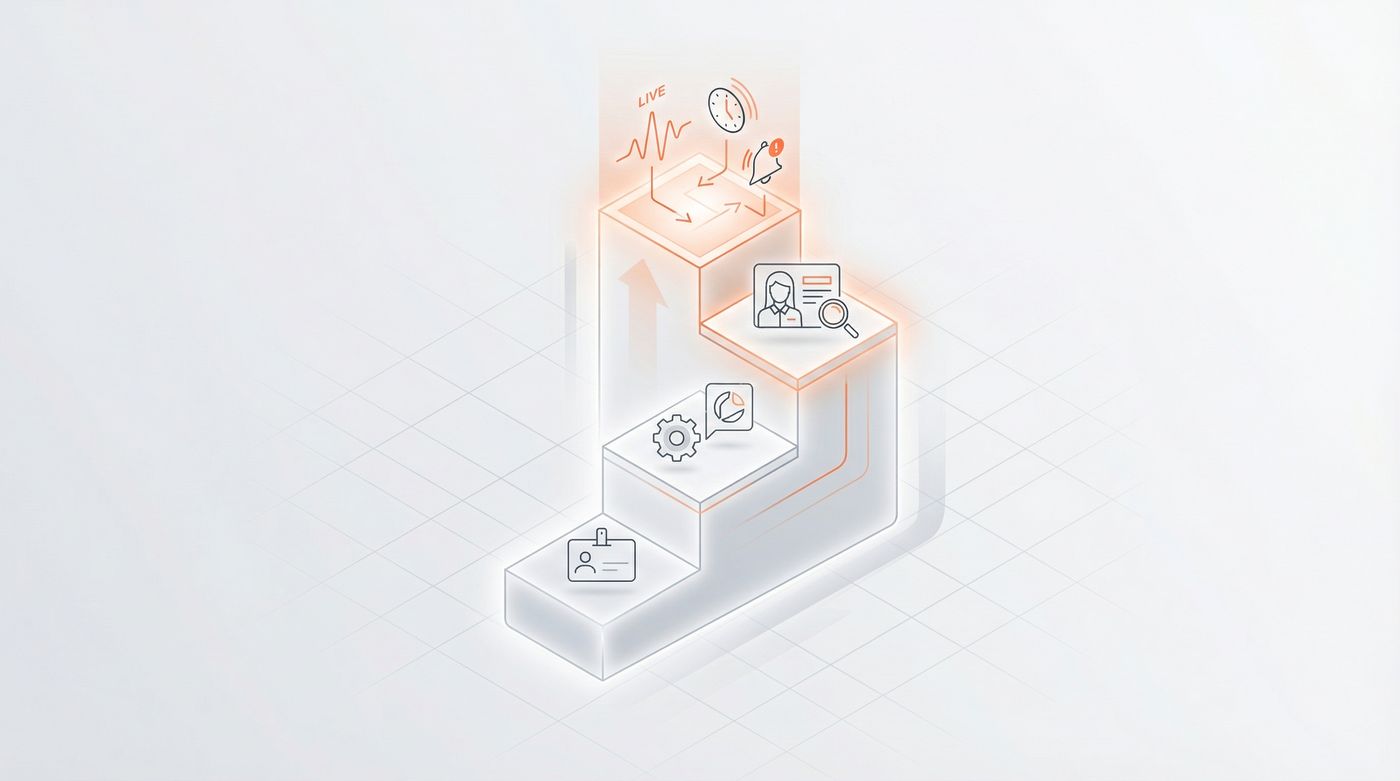
Signal monitoring tools automate the research that makes personalization work. Instead of manually checking LinkedIn, Crunchbase, and company news for every prospect, you get a feed of trigger events across your target accounts. The personalization writes itself because the signal gives you the observation, the problem inference, and the timing. This is what separates modern email strategy from the batch-and-blast approach that generates new leads but rarely converts them.
The 4 levels of personalization (from name-swap to signal-based)
Level 1 is name and company name insertion. {firstName}, {companyName}. Every email tool does this. Every prospect knows it's automated. It's table stakes, not personalization. Treat it as the floor, not the ceiling.
Level 2 is firmographic personalization. You reference their industry, company size, or job title. "As a VP of Sales at a Series B SaaS company..." This is better than Level 1 but still generic. Dozens of people match that description. The prospect knows the email could have been sent to any of them.
Level 3 is research-based personalization. You reference something specific you found: a LinkedIn post, a conference talk, a podcast appearance, a press mention. This takes 5-10 minutes per prospect. It doesn't scale past 20-30 emails per day. But the reply rates are significantly higher because the email contains information that couldn't have been generated without effort.
Level 4 is signal-based personalization. A trigger event fires (funding round, executive hire, product launch), and your email references that event, connects it to a likely problem, and offers relevant proof. This combines the specificity of Level 3 with the scalability of Level 1. The signal is the research. Tools like Signado monitor your target accounts for these triggers and surface them in real time, so the research that would take 10 minutes per prospect is already done when the signal arrives. You're writing a personalized cold email in 2 minutes instead of 12 because the hard part (finding something relevant to say) was automated.
Research that scales vs research that doesn't
Manual LinkedIn scrolling doesn't scale. Your SDR can spend 10 minutes per prospect and personalize 30 emails a day. That's a ceiling, and it's a low one.
What does scale: monitoring a defined list of target companies for public events. Cold emailing works when the timing is right, and monitoring is how you find the timing. Funding announcements, job postings, leadership changes, product launches, and executive social activity are all public information. The work is in finding them at the right time. Signal monitoring tools handle that layer so your reps spend their time on email response quality, not hunting for reasons to write them.
The personalization that gets replies in cold emailing isn't "I noticed your company has 200 employees." It's "I saw you posted 4 senior engineering roles last week, which usually means the existing team is hitting a capacity wall." The second version requires knowing about the job postings within days of them going live. That's a timing problem, and timing problems are solved by monitoring, not by working harder.
Cold email mistakes that kill reply rates: every cold email pitfall to avoid
Deliverability killers (SPF, DKIM, domain warming)
None of your email copy matters if the email lands in spam. Deliverability is the invisible variable that most cold emailing guides skip entirely.
SPF (Sender Policy Framework) tells email providers which servers are authorized to send emails from your domain. If your cold email software isn't listed in your SPF record, receiving servers flag your emails as potentially spoofed. DKIM (DomainKeys Identified Mail) adds a cryptographic signature that proves the email wasn't modified in transit. Without both configured, your emails get flagged before the recipient sees them.
Domain warming is the sales process of gradually increasing send volume on a new domain. Sending 500 cold emails from a fresh domain on day one is the fastest way to get blacklisted, even with a good cold email strategy behind them. Start with 10-20 emails per day to known contacts who will reply, increase volume by 10-20% per week, and monitor your bounce rate and spam complaints weekly. Most email automation platforms offer built-in warming, but the principle is the same regardless of tool. We tested 9 email warm-up tools head-to-head if you need a dedicated warmup solution.
Use a separate domain for cold outreach. If your primary domain is company.com, send cold emails from company-mail.com or getcompany.com. This protects your primary domain's reputation. If the cold domain gets flagged, your team's regular email marketing and internal communications are unaffected.
Copy mistakes (feature dumps, fake urgency, "just checking in")
Feature dumps are the most common cold emailing mistake. Your prospect doesn't care that your platform has "AI-powered analytics, real-time dashboards, 50+ integrations, and custom reporting." They care about one thing: solving the specific problem they have right now. Every feature you list that doesn't connect to their situation dilutes the email's impact.
Fake urgency doesn't work in B2B cold emailing. "Limited spots available" or "Offer expires Friday" might work for consumer email, but a VP of Sales who's been doing this for 15 years sees through it instantly. If your value proposition is strong enough, you don't need manufactured urgency. If it's not strong enough, urgency won't save it.
"Just checking in" is the worst follow-up email opener in cold outreach. It adds no value. It gives the prospect no new reason to reply. Every follow-up should include something the prospect didn't have before: a relevant data point, a new case study, an insight about their industry. If you don't have anything new to add, don't send the follow-up yet. Proven examples of effective follow-ups always lead with new information, not reminders.
"I hope this finds you well." Delete it. It's the email equivalent of throat-clearing. Start with substance.
FAQ
How many cold emails should you send per day?
The right number for cold emailing depends on your domain age, warming status, and sending infrastructure, not on what a blog tells you. A warmed domain with proper SPF, DKIM, and DMARC records can handle 75-150 sends per day per inbox. A fresh domain should start at 10-20 and increase by 15-20% weekly. The real limiter isn't volume, it's reply rate. If you're sending 200 emails a day and booking one meeting, the problem isn't the cap. It's the targeting.
What is a good reply rate for cold email?
Death to Cold Emails' 2026 benchmarks put the average B2B SaaS cold email reply rate at 3.7%, with a 1.0% meeting conversion rate (Death to Cold Emails, 2026). If you're above 5%, your targeting and copy are working. Above 10% means your personalization is genuinely landing. The signal-based campaigns that hit 15-25% (Autobound, 2026) aren't magic. They're the result of sending fewer emails to better-timed prospects. The best teams optimize for reply quality, not reply volume. A 3% reply rate where half the replies are "not interested" is worse than a 2% rate where every reply is a conversation.
Most b2b cold email templates fail because they solve the wrong problem. They optimize for what to say when the real question is when to say it and why this prospect should care right now. The templates in this guide give you proven structures and proven examples. The frameworks tell you how to fill them. But the variable that moves reply rates from 2% to 15% is matching the right template to a real trigger event at the prospect's company.
If you want to automate that matching, that's what signal monitoring tools do. Signado tracks funding rounds, leadership changes, hiring surges, and five other trigger types across your target accounts, then surfaces the context you need to write emails that reference specifics rather than guessing. See how it works.
The best email you send this quarter won't be the one with the cleverest subject line. It'll be the one that arrives the same week the prospect's problem became urgent. Templates give you the words. Signals give you the timing. You need both.
Land your next client with something relevant to say
Signado finds the people already talking about what you do on LinkedIn, and shows you what they actually said. You reach out with a reason they'll recognize.